Marketing storytelling in B2B often breaks down as companies grow, not because teams stop producing work, but because the work stops reinforcing itself.
As companies grow, communication expands. More people contribute, more channels appear, and the product continues to evolve. What once felt clear starts to fragment.
At that point, coherence is the challenge rather than output.
Not as polish or brand narrative layered on top. As a discipline that keeps communication aligned as the business changes.
In this article:
- Why B2B marketing becomes harder as companies grow
- Doesn’t strong positioning solve all of this?
- What narrative is, and how it works in practice
- How does narrative drive growth?
- How founders should think about narrative
Why does B2B marketing become harder as companies grow?
B2B marketing becomes more challenging as companies grow because clarity does not scale as easily as activity.
In the early days, communication happens directly. Founders understand their product implicitly, and the explanation is instinctive, even if incomplete.
Growth changes those conditions because:
- The product evolves beyond its original use case
- More stakeholders contribute to how it is described
- New audiences require different levels of explanation
- Expectations around visibility and output increase
In response to this, the natural impulse is to add:
- More explanation
- More use cases
- More messaging variations
But each addition introduces minor variations, and those variations accumulate. What once felt obvious becomes harder to hold onto across teams, channels, and moments.
In cases like this, nothing necessarily feels broken: Output is increasing and work is shipping. But the core message is no longer as easy to explain, repeat, or recognise.
What breaks as communication expands?
In reality, what breaks is coherence, not effort. Teams continue producing. Content goes live. Campaigns move forward. Decisions are made quickly.
A company might describe itself one way on its website, another way in sales conversations, and a third way in product.
The homepage focuses on efficiency. Sales leans on flexibility. The product team talks in terms of features and technical capability.
Each version is valid, but a buyer moving between those touchpoints has to do the work of connecting them, and that compromises momentum.
This is precisely why “doing more” doesn’t solve the problem.
Without something holding communication together, each new piece of work adds variation instead of strengthening the whole.
Doesn’t strong positioning solve all of this?
Positioning defines where you stand. It does not ensure that position is communicated consistently. As April Dunford puts it, “Positioning defines how your product is a leader at delivering something that a well-defined set of customers cares a lot about.”
Most teams invest in positioning.
They define their market, clarify their audience, and identify what makes them different.
Positioning lives in documents
Positioning is usually captured in a document. A strategy deck. A workshop output. Something teams can refer back to.
But the work does not happen there.
Communication happens under pressure
It happens in messaging, campaigns, content, sales conversations, product updates. In all the places where decisions are made quickly and context keeps changing.
Each piece of communication adapts to its immediate goal. A campaign leans into one angle. A sales conversation emphasises another. Product language shifts to reflect new features or priorities.
None of these decisions are wrong in isolation.
But they are made locally.
The original positioning is still present, but it is no longer shaping every choice. It becomes something teams check against, rather than something they actively operate from.
That gap is where inconsistency begins.
Most positioning work fails the moment it leaves the document.
What is narrative in a B2B context?
Narrative is the structure that allows positioning to hold under pressure. It shapes decisions in practice, defining what gets prioritised, how messages are framed, and what is left out. This is where marketing storytelling in B2B moves from expression to structure.
It exists to keep communication consistent as it spreads across teams, channels, and decisions rather than to make marketing sound better.
As Andy Raskin puts it, “the entire organization must align around the narrative about change.”
That “change” is the shift you are asking the market to believe in. The new way of operating, thinking, or solving a problem that makes your product/service relevant.
That alignment is what most teams struggle to maintain as they grow.
Narrative acts as a constraint
In practice, narrative works by limiting variation:
- Defining how the product is explained
- Setting boundaries on what gets emphasised
- Removing the need to reinvent the message in each context
This is what creates consistency: ensuring that teams are working from the same underlying logic rather than simply using the same words.
Narrative holds under pressure
Decisions need to be made quickly, different people are communicating externally, and priorities are shifting.
In these moments, teams do not have time to revisit positioning documents.
They rely on what holds. It shapes decisions before they are made, not after they are reviewed.
Without it, communication becomes reactive to each situation. The message shifts depending on context, and consistency starts to erode.
How does narrative drive growth?
In B2B storytelling, narrative drives growth because it allows communication to compound rather than reset.
Clarity matters, but clarity alone does not create momentum.
When the same core idea is reinforced across the website, sales conversations, content, product messaging, and leadership communication, the business becomes easier to recognise and easier to trust.
Growth demands reinforcement
Marketing works better when each message builds on the last.
A prospect reads a point of view on LinkedIn. Visits the website. Sees the same logic reflected in the homepage, product explanation, and customer proof. Speaks to sales and hears that same idea carried through clearly.
Narrative does more with less
Without narrative, every interaction has to do too much work.
The business keeps reintroducing itself from slightly different angles. Teams explain more, not because the offer is complex, but because the message is unstable.
Narrative reduces that drag. It gives the market a clearer signal. It helps buyers connect the dots faster. And it allows marketing activity to build cumulative value rather than operating as a series of disconnected outputs.
That is why narrative supports growth.
It makes communication easier to recognise, repeat, and act on, rather than simply sounding better, and that consistency comes from better decisions, not just clearer messaging.
What happens when B2B narrative is missing?
Without narrative, communication becomes heavier. Teams compensate by adding more explanation, but without a structure to guide it, the message becomes harder to follow. This is where storytelling in B2B marketing starts to lose its impact.
The same patterns begin to appear.
- explanations get longer as teams try to cover every angle
- messages shift depending on context, audience, or channel
- product language starts to dominate, because it feels safest
The cost shows up in everyday work
Content performs inconsistently. What works in one place does not translate to another.
Teams duplicate effort, reworking the same ideas from slightly different angles without building on what already exists.
Messaging needs constant adjustment. Decisions that felt settled are revisited as new contexts emerge.
More content is produced. More campaigns are launched. More variation is introduced in an attempt to find what lands.
More activity does not fix the problem
The underlying issue remains. Without a clear narrative, each new piece of communication adds weight instead of strengthening the whole.
The message does not compound. It resets. There is no structure holding it together.
How should founders think about narrative?
Narrative is not something separate from marketing. It is what allows marketing to work.
One way to think about it:
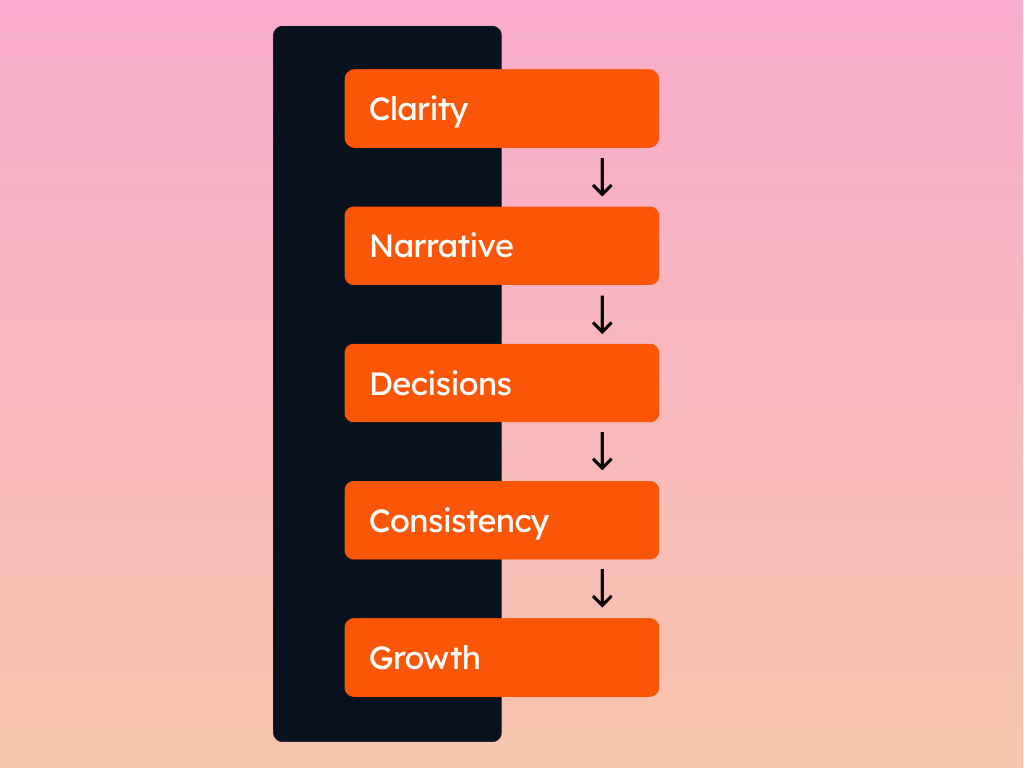
Clarity defines what the business is trying to communicate. But clarity on its own is not enough once communication spreads across teams and channels.
Narrative is what translates that clarity into something teams can operate from. It shapes how decisions are made in context, not just how ideas are defined in theory.
Narrative turns clarity into consistent decisions
When narrative is clear, teams do not need to reinterpret the message each time they act. This means that:
- Decisions require less effort
- Fewer trade-offs need to be revisited
- Communication becomes easier to stand behind
Where should you focus first?
Start with what needs to hold, not what needs to be said.
That instinct to “explain more” is understandable, but it works against both clarity and impact in the long term. Often, it makes sense to start from the other way around. What can’t change, rather than what needs to change.
Focus on what needs to stay consistent
Before expanding communication, teams need to decide what cannot change. This should include:
- The core idea that should be recognised across every touchpoint
- The way the product is explained at a fundamental level
- The boundaries of what will and will not be emphasised
This is where clarity is either strengthened or diluted.
Constraint is a decision, not a limitation
The pressure is to expand. To cover more ground. To say more to appeal to more people.
But clarity depends on what is excluded as much as what is included.
Constraint is not a limitation. It is what allows communication to stay coherent as it scales.
Without that structure, marketing storytelling in B2B becomes harder to sustain as the company grows.
We help founders define what should hold and bring their communication back into alignment.